
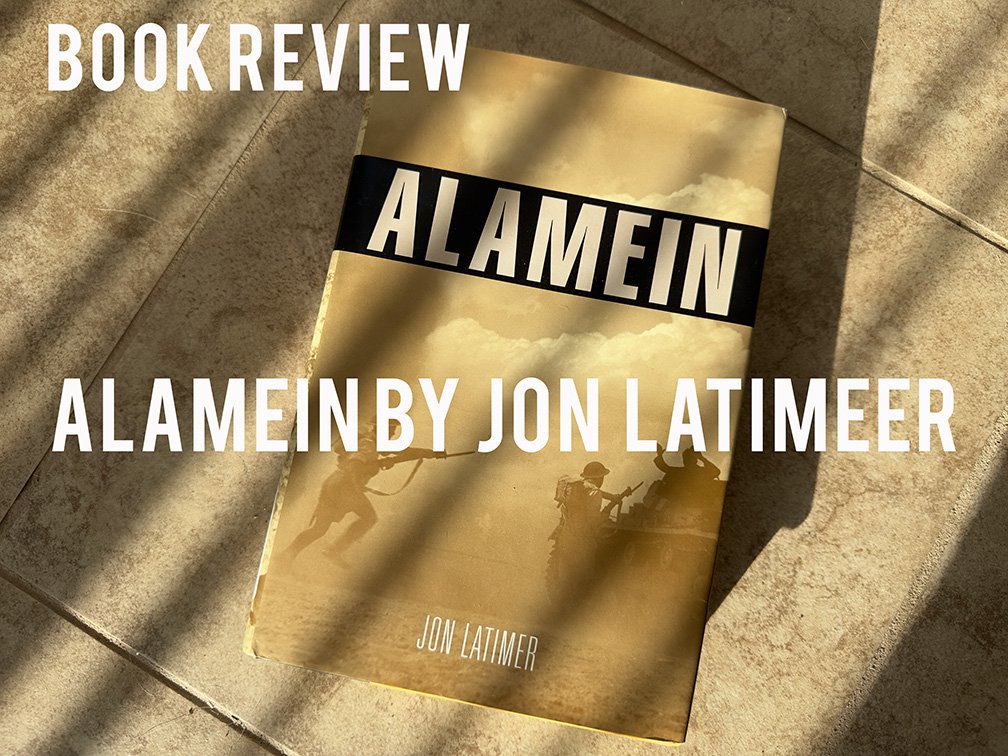
I need to fill some holes in my education on the subject of World War 2. Okay. A lot of holes. My grandfather covered a lot of ground in the course of his service. In his books, letters and notes, he, naturally, focuses on his own activities. But I think for the documentary to have some depth, I need to know more details about the world around him, especially in the North African and Italian theaters. I don’t think I’ve ever read a detailed book about those campaigns. I vaguely know some of the places involved and a lot of that knowledge came from watching war movies. I’m looking at you, Patton. While my grandfather’s book does have some information through contemporary accounts like the British 8th Army News, I don’t believe I’m getting a deep picture of what is going on. Granted most of what I pick up will never make it into the documentary, I still need to know.
The first big battle that involved the 57th Fighter Group was the battle at El Alamein. I know the name. I know that Rommel and Montgomery where the two lead guys for the Germans and the Brits. After that, I’m not winning much money on Jeopardy with correct answers.
Alamein by Jon Latimer aimed to change my lack of knowledge. Suddenly, the cast of characters swelled enormously. I learned tank types and plane types and ship types. I learned about the different army groups, because it is all about the groups. And I learned a lot about the geography of the Western Desert of Egypt.
The book has almost too much information for a first go round. The amount of information coming at me was enormous, almost too much. I struggled trying to remember who was who and what role they played in the battle. Latimer talks about everyone from the guys on the ground, to the men in the tanks, and the guys calling the shots. I think there were 300,000 people at the battle of El Alamein. Most of them are mentioned in the book.
After keeping the people straight, I had a big difficulty keeping the different groups straight. It took another book to help me know that an army is made up of corps and corps are made of divisions and divisions are made of brigades and brigades are made of battalions. They all have different numbers and countries of origin. Now, that is not Latimer’s fault that I’m ignorant. Alamein is a dense book. There is a lot going on over the course of the 11 days of battle.
The book is at it’s best moving away from the large scale moving parts and getting down to the personal stories. There are a lot of good first hand accounts of peoples actions. And by good, I mean horrific. The tales of deaths and destruction make you wonder why wars are fought in the first place.
Two descriptions that really stick in my mind have to do with the infantry. The first is during certain battle, the attack plan calls for the artillery to walk their target areas forward and for the infantry to follow in the wake of the shells landing. Multiple times the infantry is caught too close to the explosions or the shells fall down right on top of them because someone miscalculated the distance.
The second concerns minefields. As both sides prepared for the El Alamein battle, they planted thousands of mines all across the area of battle. Before the battle could be engaged, the mines had to be cleared or at least paths through the minefields had to be opened. The Brits referred to one minefield the Germans had laid as the Devil’s Garden. Not much description was given to how the minefield was cleared, in some cases special vehicles detonate the mines, but in most cases a group of men just went ahead and found them. That’s bad enough. But these battles mostly took place at night and so did the mine clearance. The thought of going into a minefield to clear mines when it is pitch black out, while of course hot metal zips all around, is nightmare fuel.
In conclusion, I felt the book was very well written. It puts in you in a particular place and time with great clarity. I think for me to get the full effect of the book and have it sink in, I will have to read it again. Thank god for all the maps.
Discounts, Giveaways, & Other News
Max one email per week


0 Comments