
When I started to consider the documentary about my Grandfather’s book, it occurred to me that in all the research I had done, a viewpoint was missing. Why don’t I see in any of the popular depictions of the Desert War what the Egyptians, Libyans and Tunisians thought of the conflict? Maybe I am ignorant because I have never looked for those viewpoints.
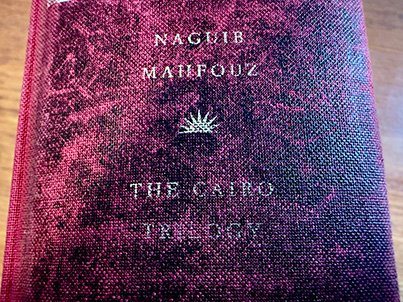
In order to cure my lack of knowledge, I have opted to read a few books from the Egyptian perspective. The Cairo Trilogy was the series that jumped to the top of my search lists when I started my research. The author, Naugib Mahfouz, is the only African author to win the Nobel Prize for literature. I thought I should go with the Noble Prize winner.
Palace Walk, Palace of Desire, and Sugar Street make up the three books in the Cairo Trilogy. Mahfouz envisioned the trilogy as one mammoth book. Despite his reputation at the time, no one wanted to publish it. So, the book was broken up to the three volumes. The edition I had was just one massive 1500 page that made for simply physically difficult reading. I’ll get why it was emotionally difficult reading in a bit.
At this point, I have only read Palace Walk but I am well on my way into Palace of Desire. Each book represents a different street in the Gamaliya district where Mahfouz grew up. Palace walk introduces us to the al-Jawad family with patriarch Al-Sayid ruling the family with stern discipline. His wife Amina only gets to leave the house for rare visits to visit her mother. His daughters Khadijah and Aisha will only get to leave the house when they marry.
Al-Sayid’s three sons have more freedom but still live in terror of their father. Yasin, the eldest from Al-Sayid’s first marriage, works as government clerk, but we never really see him at his job. Fahmy studies to be a lawyer while pining for the neighbor girl who he only has ever had brief glimpses of from the rooftop garden. Kamal goes to primary school and likes to cause some mischief around the house.
The book never travels far from the main house. We see the grocery store owned by Al-Sayid. There are forays to nightclubs. Amina gets to visit the mosque of her favorite saint while Al-Sayid is away overnight. But there are only glimpses of these other places. Mostly it’s the house and the people sort of trapped inside. They are always guessing about how the father will react to any of their actions. The whole family seems stunted.
But the crazy thing is, Al-Sayid is a flaming hypocrite. Every night he goes out drinking with his his friends and his current lover. He sings and dances and jokes around with his friends. Meanwhile, Amina waits at home. She wakes when she hears him stumble in. And what does she do? She helps him takes his clothes off. Makes sure he has water for washing. Holds the lamp so he can see. Amina wouldn’t dare ask him what he’s been up to.
But when Amina leaves the house, Al-Sayid grows furious with her. She broke his house rules. He kicks her out of the house and she goes to live with her mother for awhile. When Al-Sayid gives her the ultimatum to leave, he tells her he doesn’t want to see her when he gets home.
To my way of thinking, it is all just madness. But Palace Walk does give a view of a culture I know nothing about. Their lives are full of religion. The whole family constantly quotes the Koran and begs for intercession from God on most activities. There are arranged marriages. I read a lot about the house is run. There is also the vices. Al-Sayid isn’t the only one unfaithful. All his friends seem to share the same vices. The whole circle drinks to excess every night, something I would have not thought was part of Egyptian culture.
My desire to see how they interact with the English only pays off in bits and pieces until near the end. Up until then, the complaints are mostly about the Australians and how they have made the Ezbekaya Gardens off limits. The Australians have there headquarters in there so the locals are barred.
That changes for about the last quarter of the book when details of the 1919 revolution creep into Palace Walk. The streets are now full of English soldiers, some camped right in front of the house. Amina is terrified when she learns that Fahmy has been doing the dangerous work of handing out pamphlets. At the mosque, Yasin is accused of being a spy and is almost dragged into the street to be punished. Even Al-Sayid gets caught up in the demonstrations. One night coming home from his regular drinking bout, he is dragooned by the soldiers and is made to help fill a hole in the street made by the demonstrators.
In 1919, at least all is not good between the British and the Egyptians. I know the tension lasts until at least 1952. In his diaries, my grandfather talks about staying at the world famous Shepheard’s Hotel. He also spent some nights at the Badia Casino across the street. To come full circle, both are right next to Ezbekaya Gardens.
I figured I would visit both locations when I went to Cairo and take some photographs. But neither exist today, despite their fame. Both, and much else, were burnt down in 1952 as part of demonstrations against the British. The origin of the great Cairo Fire was the Badia Casino. It’s clear there was tension between Egyptians and the English all through World War 2.
Most reviewers cite the poetry of Mahfouz’s language as why the Cairo Trilogy is such a great work. I didn’t see it. The writing all seems stiff and bald. Very direct. I wonder if the poetry comes from the Arabic language? It certainly does not come across in the English translation.
But I’m glad I’m reading this. I value the different perspective I am seeing.
Discounts, Giveaways, & Other News
Max one email per week

0 Comments